
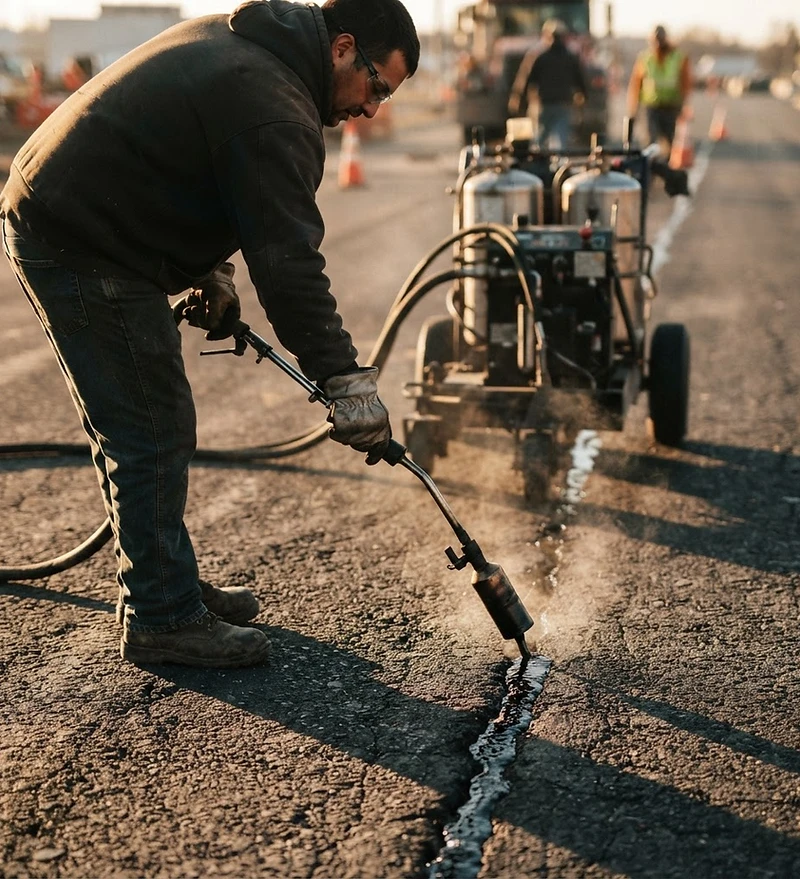
The region's leader in
hot pour
crack filling.
Professional rubberized crack sealing for asphalt driveways and parking lots across the Washington DC metro — done hot, routed, and filled the way the spec demands, not the way it's usually skipped.
Why hot pour wins.
Cold-pour filler from a hardware store lasts a season. Professional hot pour crack sealing — rubberized sealant heated to ~400°F and forced into the crack — bonds, flexes, and waterproofs for years. It's the standard the rest of the region doesn't bother to meet.
The Joe difference
Routed, cleaned, and filled properly — every crack, every time.
Waterproof seal
Stops water from penetrating and eroding the sub-base — the #1 cause of pavement failure.
Flexes with freeze-thaw
Rubberized sealant stays elastic through DC's temperature swings, expanding and contracting without splitting.
Bonds to asphalt
Applied at ~400°F, the sealant fuses to the crack walls for a bond cold-pour can't match.
Prevents edge breakdown
Sealed cracks stop the spider-web of secondary cracks that turn a hairline into a pothole.
Extends pavement life
Proper crack filling can add years to a driveway or lot before overlay or replacement.
Highest-ROI maintenance
Dollar for dollar, the most cost-effective way to protect an asphalt investment.
The Crack-Fill Method
Four steps, done right. Skip the routing and cleaning and you've wasted the sealant — so we never skip them.
Route & Clean
We route out cracks to a clean, uniform channel and blow out all debris, vegetation, and moisture — the bond starts with a clean wall.
Cracks routed & air-blasted
Heat the Sealant
Rubberized block sealant is melted in a dedicated kettle to ~400°F and held at temperature so it flows and bonds properly — not a cold pour from a jug.
Sealant held at ~400°F
Fill bottom-up
Molten sealant is poured into the crack, filling voids and fusing to the walls, with a slight overfill for the squeegee pass.
Bottom-up fill, no voids
Squeegee & Cure
We level the sealant flush, squeegee a clean line, and let it cure. Traffic-ready the same day — a sealed crack that flexes with the seasons.
Traffic-ready same day
The heat, on camera.
We read our work in thermal. At ~400°F the sealant shows bright against cold asphalt — proof the pour is hot, the fill is complete, and the bond is real.

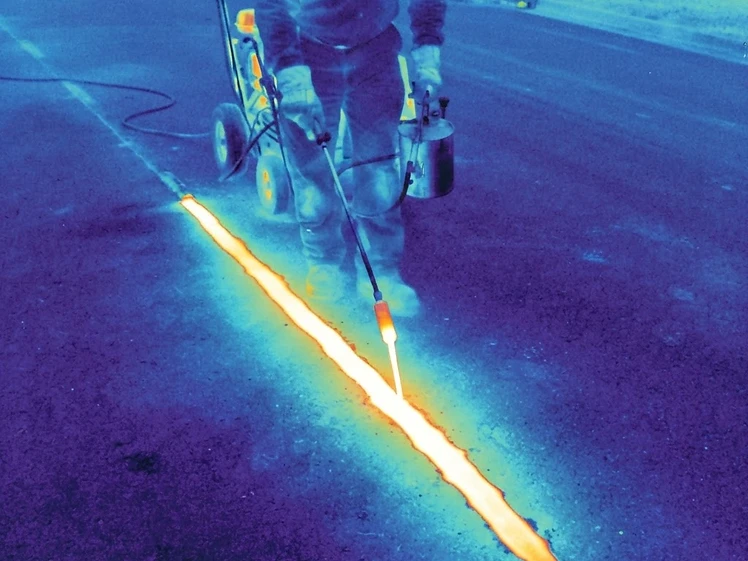 THERMAL / POUR
The pour, in IR
Bright orange-white is the molten sealant at temperature, fusing to the crack walls before it cools. No cold pour glows like this.

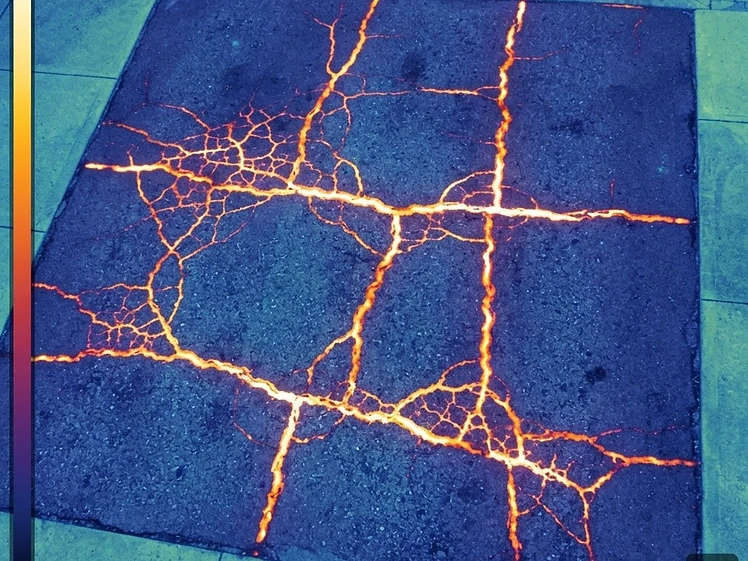 THERMAL / RESULT
The fill, verified
Warm lines across cool pavement confirm every crack is filled edge-to-edge with no voids — the bond you can't see with the naked eye, made visible.
Driveways and parking lots — same standard.
Driveways
Residential crack filling protects your driveway's sub-base through DC freeze-thaw cycles and keeps a clean, sealed surface.
Get a Residential EstimateParking Lots
Commercial crack sealing is the first line of defense for your lot — stop water intrusion before it turns into potholes and liability.
Get a Commercial Estimate
