
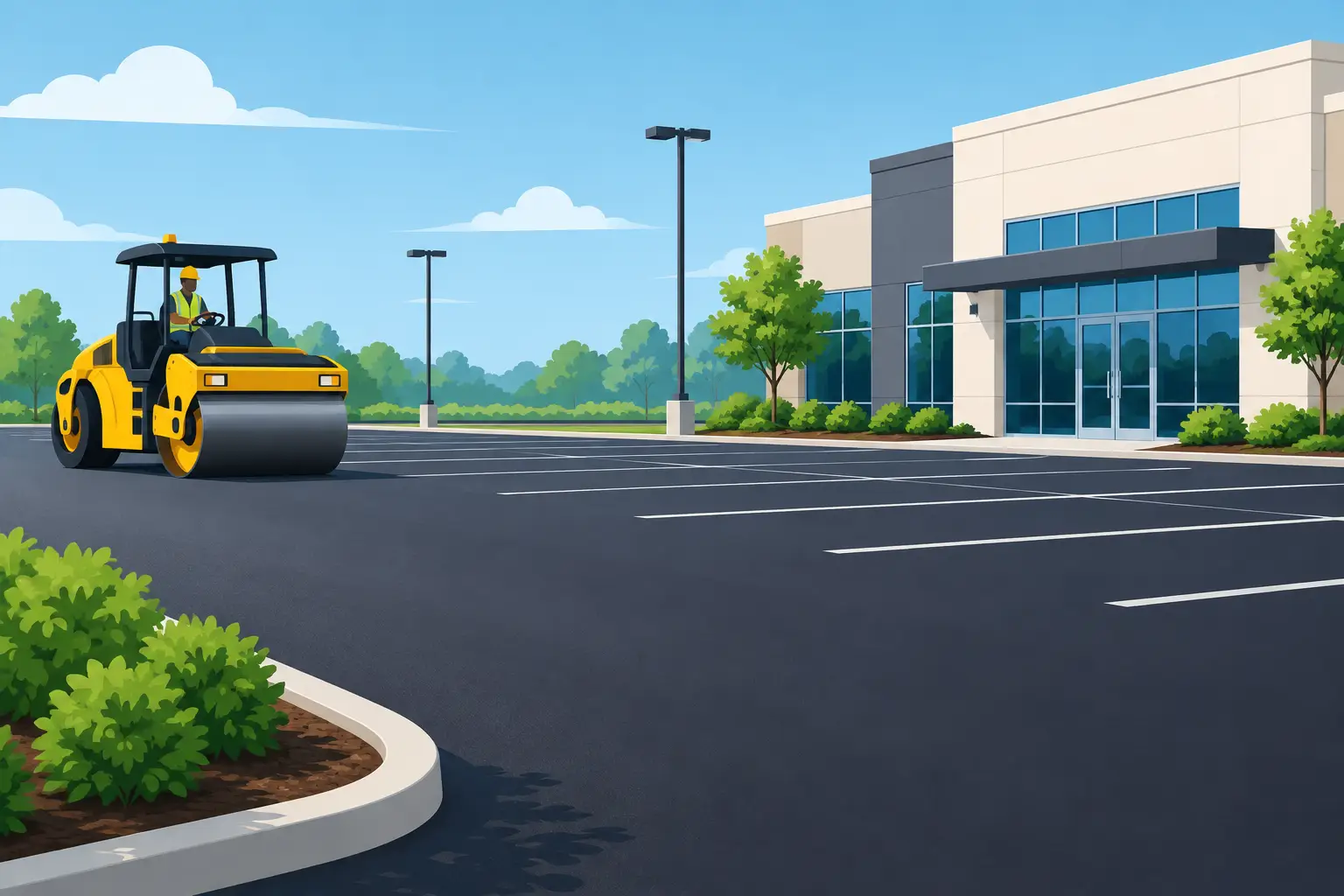
A parking lot rarely gets a second chance to make a first operational impression. When potholes catch carts, striping confuses drivers, or drainage leaves standing water at the entrance, the issue affects more than appearance. Commercial parking lot paving is a capital decision that influences safety, traffic flow, tenant satisfaction, and the cost of owning the property over time.
For facility managers and property owners, the right question is not simply, “What will it cost to pave?” It is, “What work will give this site the longest useful life with the least disruption to operations?” The answer depends on pavement condition, traffic loads, drainage, access requirements, and whether the property needs a targeted repair or a full reconstruction.
Start With the Pavement You Have
Pavement failures usually tell a story. Fine surface cracks may point to aging asphalt and oxidation. Alligator cracking, where the surface breaks into interconnected pieces, often signals a base failure beneath the asphalt. Depressions near drains may indicate drainage problems, while potholes and raveling can result from water intrusion, weak subgrade, or repeated heavy loads.
That distinction matters because a smooth new surface cannot correct a failed foundation. An overlay can be a cost-effective option when the existing pavement is structurally sound and has been properly repaired. If the base is unstable, however, paving over it may only hide the problem temporarily. The new asphalt can crack in the same areas as traffic and moisture continue to work on the underlying failure.
A qualified site assessment should look beyond the visible surface. It should identify damaged areas, evaluate drainage paths, consider vehicle types and traffic frequency, and review transitions at sidewalks, loading areas, entrances, and catch basins. This early work helps prevent scope changes after crews arrive and gives decision-makers a clearer basis for budgeting.
Choose the Right Scope for Commercial Parking Lot Paving
There is no single paving solution that fits every commercial property. The practical choices generally fall into four categories: maintenance and localized repair, mill and overlay, full-depth reclamation, or removal and replacement.
Crack sealing, patching, sealcoating, and restriping can extend the service life of pavement that is still fundamentally sound. These services make sense when distress is limited and water has not compromised the base. They are also useful as part of a recurring site-care plan, especially for large portfolios where postponing every expense can quickly become more costly.
Milling and overlay removes a controlled depth of existing asphalt before new material is installed. This approach can correct surface irregularities and preserve important elevations at curbs, doorways, and drainage structures. It works best when the underlying base has adequate strength and the pavement failures have been addressed before the overlay begins.
Full-depth reclamation or complete replacement is a larger investment, but it may be the responsible choice for lots with widespread structural failure. In those cases, rebuilding the base and asphalt section creates a new pavement system designed for the site’s traffic. A retail parking field used mainly by passenger cars has different needs than a distribution yard supporting daily tractor-trailer traffic. Thickness, base preparation, and mix design should reflect that difference.
Drainage Is Part of the Paving Work
Water is one of asphalt’s most persistent enemies. It enters cracks, weakens the base, freezes in colder service areas, and creates soft spots that fail under vehicle loads. A lot can look well paved on completion day and still deteriorate early if water is being directed into the wrong places.
Before work begins, review where runoff travels during a hard rain. Pay close attention to low areas, inlets, curb lines, loading docks, dumpster pads, and building entrances. The paving plan may need to include grading adjustments, drainage repairs, catch-basin work, or careful tie-ins to existing pavement so water moves to intended collection points.
Drainage considerations also affect accessibility and daily use. Improper slopes can create ponding near accessible parking spaces or pedestrian routes. Poor transitions can direct water toward storefronts or make carts difficult to move. These details may appear minor on a drawing, but they have a direct effect on site safety and customer experience.
Plan Around Traffic, Tenants, and Deliveries
The best paving plan is not useful if it blocks the property from operating. Commercial sites need a phasing strategy that keeps entrances, fire lanes, deliveries, customers, employees, and tenants moving as safely as possible.
That usually starts with identifying nonnegotiable access points and high-traffic periods. A medical office may need uninterrupted patient access. A retail center may need work scheduled around weekend traffic. An industrial site may require truck routes to remain open throughout the project. In some cases, night or weekend work reduces disruption. In others, daytime work is safer and more efficient because it allows better visibility and coordination.
Clear communication matters as much as the schedule itself. Tenants, delivery partners, and onsite teams should know which areas will be closed, where temporary parking is available, and how traffic patterns will change. Temporary signs, barricades, flagging, and visible work-zone boundaries help protect visitors and crews alike.
Weather also deserves realistic attention. Asphalt work depends on suitable temperatures and dry conditions, while striping and coatings have their own curing requirements. A contractor should build reasonable flexibility into the schedule rather than promise dates that ignore weather, material availability, or site access constraints.
Do Not Treat Striping as an Afterthought
Once asphalt is placed, the job is not finished. Striping and pavement markings organize the way people move through the site. They define stalls, accessible spaces, fire lanes, crosswalks, loading zones, directional arrows, and no-parking areas. Faded or confusing markings increase risk and make even a newly paved lot feel neglected.
A paving project is a good time to review the traffic pattern itself. Are spaces arranged efficiently? Are pedestrian crossings visible? Is the delivery route separated from customer traffic where possible? Do accessible routes, ramps, signs, and markings align with current requirements? These questions should be handled before striping begins, not after crews have left the site.
The same principle applies to curbing, wheel stops, bollards, signage, and drainage structures. Coordinating these elements as part of the site plan avoids expensive rework and gives the finished property a more orderly, professional appearance.
Evaluate Contractors by Planning and Accountability
Price matters, but the lowest bid is not always the lowest cost. A scope that omits base repairs, drainage work, traffic control, protection of adjacent surfaces, or proper cleanup can create change orders and operational problems later. Compare proposals based on what is included, the recommended construction method, proposed materials, phasing, safety approach, and warranty or follow-up expectations.
For multi-property owners and managers, regional service capability can simplify coordination. Blacktop Joe supports commercial paving and ongoing site care across multiple southeastern and Midwestern markets, giving customers a single partner for projects that may span more than one location. The value is not only in completing a paving project, but in having a clear plan for preserving the pavement after installation.
Ask who will manage the project onsite, how the contractor will communicate schedule changes, and what steps will be taken to protect pedestrians, vehicles, and building access. Reliable contractors explain trade-offs plainly. They should be willing to say when a lower-cost repair is appropriate and when it is likely to be a short-term fix.
Protect the Investment After Paving
New asphalt needs ongoing attention. Keeping the surface clear of debris, addressing spills, monitoring drainage, sealing cracks before water reaches the base, and repairing isolated failures early can slow the aging process. Sealcoating can help protect pavement from oxidation and improve appearance, but it is not a substitute for structural repair.
A maintenance plan is especially valuable for properties with heavy traffic, multiple buildings, or budget cycles that require advance planning. Regular inspections turn pavement care from a surprise expense into a managed asset strategy. They also help teams prioritize work, whether that means repairing a failing drive lane this season or scheduling an overlay before cracking spreads across an entire parking field.
The goal is not to pave more often. It is to make each paving decision last. When the scope matches the pavement condition, water is managed correctly, and routine care continues after construction, the parking lot can support the property instead of becoming the next urgent problem.