
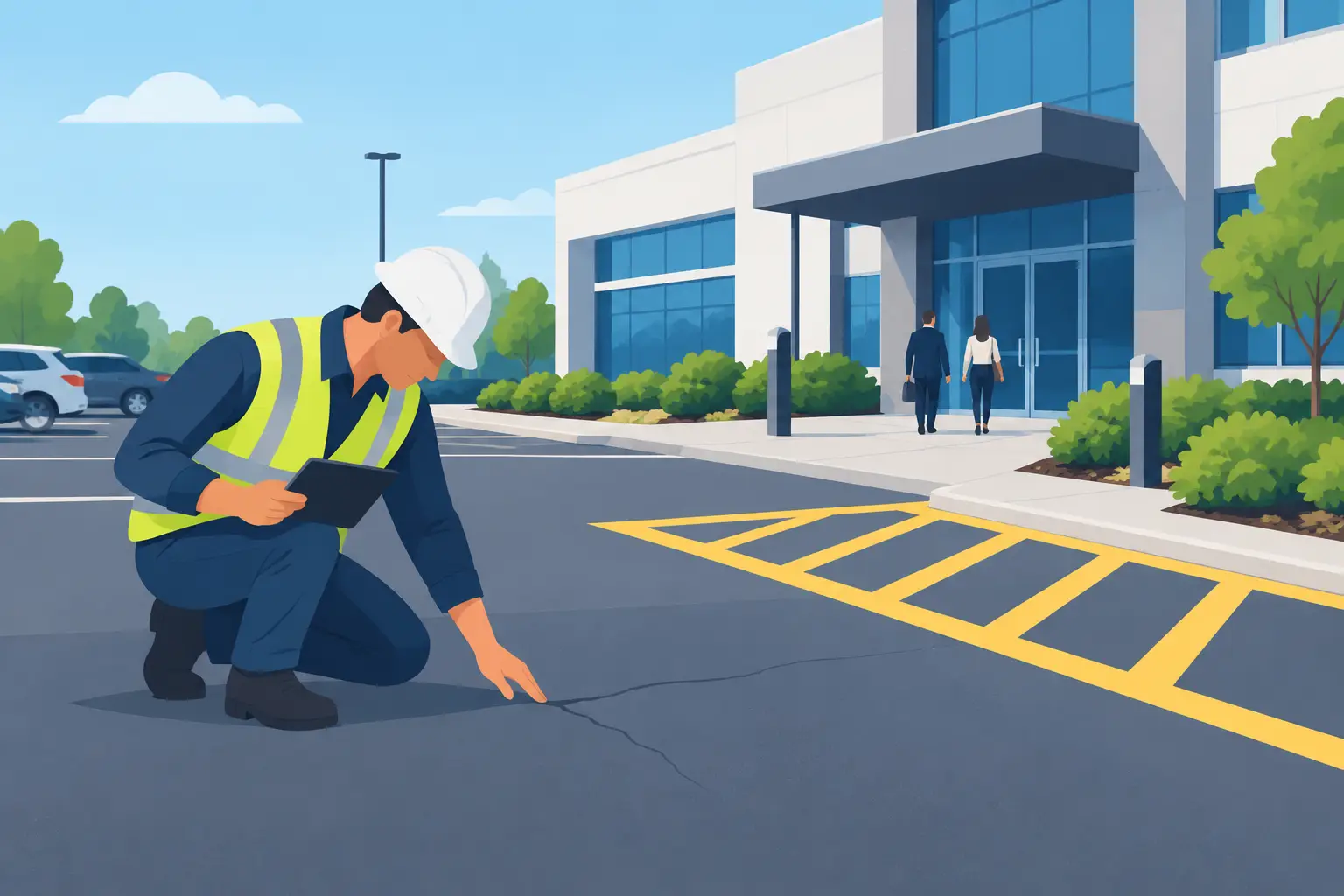
A cracked sidewalk at a storefront entrance, faded crosswalk near a medical office, or pothole in a loading area can become a real operational problem before anyone calls it a paving problem. Pavement safety compliance is the ongoing work of identifying, correcting, and documenting conditions that could affect people, vehicles, accessibility, or day-to-day site access.
For property and facility teams, the goal is not to make every surface look brand new at all times. It is to keep the site functional, clearly organized, and reasonably safe for the people who use it. That requires regular attention, practical priorities, and a contractor who understands how repair work affects an occupied property.
What Pavement Safety Compliance Covers
Pavement safety compliance is broader than filling potholes. It includes the condition of asphalt and concrete surfaces, traffic flow, pedestrian routes, parking layout, drainage, markings, and the way repair work is managed while a site remains open.
The exact requirements vary by property type, municipality, lease obligations, insurance expectations, and applicable accessibility standards. A retail center with steady customer traffic has different concerns than an industrial yard with truck movements and restricted employee areas. Still, most commercial properties need to manage the same core risks: trips and falls, vehicle damage, poor visibility, blocked access, standing water, and unclear traffic patterns.
A practical compliance program starts with a simple question: can a visitor, employee, delivery driver, or emergency vehicle move through the property safely and predictably? If the answer is uncertain, the site needs attention.
Common Conditions That Create Safety Exposure
Many pavement issues develop slowly. That can make them easy to defer until a complaint, incident, or weather event makes the problem harder to ignore. Regular inspection helps property teams catch conditions when repairs are smaller, less disruptive, and less expensive.
Cracks are often the first visible sign of pavement movement or water intrusion. Small cracks may be suitable for sealing, while wider or interconnected cracking can point to a weakened base that needs more substantial repair. Left untreated, water reaches the pavement structure, freeze-thaw cycles can worsen damage in colder markets, and traffic continues to break down the surface.
Potholes and surface depressions create obvious trip and vehicle hazards. They also collect water, hide their depth during rain, and accelerate surrounding pavement failure. At entrances, accessible parking areas, drive lanes, and loading zones, these repairs usually deserve prompt action.
Uneven transitions are another frequent concern. A raised edge where asphalt meets concrete, a settled utility cut, or a heaved sidewalk panel can affect carts, wheelchairs, pedestrians, and low-clearance vehicles. These conditions should be evaluated for both immediate risk and the underlying cause. A quick patch may restore a safer transition, but drainage failure or base movement may require a longer-term correction.
Faded striping is easy to underestimate. Parking stalls, fire lanes, crosswalks, directional arrows, stop bars, loading areas, and accessible parking symbols help users understand how the site is meant to function. When markings lose visibility, drivers improvise. That can lead to blocked lanes, parking conflicts, pedestrian exposure, and difficulty maintaining emergency access.
Inspect the Site Like a User Would
A useful pavement inspection does not happen only from a vehicle or only in daylight. Walk the property at the pace of a visitor. Drive it as a delivery driver would. Look at it after rainfall, during early morning hours, and when the lot is busy enough to reveal traffic conflicts.
Pay close attention to entrances, pedestrian paths, curb ramps, accessible parking spaces, storefront approaches, dumpster areas, loading docks, fire lanes, and transitions between different surface types. These are the places where traffic concentrates and where small defects can have an outsized effect.
Document what you find with dated photographs, notes on location, and a description of the condition. A simple site map can help identify repeat issues, such as a low area that ponds after every storm or a section of drive lane that continues to ravel under truck traffic. Documentation supports repair planning and demonstrates that the property is being actively managed.
Inspection frequency depends on the site. A high-traffic retail property, healthcare facility, multifamily community, or industrial operation may need routine walk-throughs and seasonal pavement reviews. A lower-traffic office property may need fewer formal inspections, but should still be checked after storms, winter weather, utility work, or tenant changes that alter traffic patterns.
Prioritize Repairs by Risk, Not Appearance Alone
Not every defect requires the same response. The best repair plan separates immediate hazards from conditions that can be scheduled as part of preventive maintenance.
Conditions that interfere with pedestrian access, emergency routes, vehicle circulation, or accessible parking should move to the front of the line. So should potholes, significant surface breaks, standing water in travel paths, and missing or unclear safety markings. Temporary measures may be appropriate when a permanent repair cannot happen immediately, but temporary solutions should be clearly marked, monitored, and replaced with a durable fix when conditions allow.
Other work can often be grouped for efficiency. Crack sealing, sealcoating, restriping, localized patching, and curb repairs may be planned together to reduce mobilization costs and minimize disruption. This is where a maintenance plan becomes valuable. It turns repeated reactionary repairs into a scheduled approach that protects the pavement asset over time.
There is a trade-off between the lowest immediate cost and the lowest long-term cost. A patch can address a localized failure quickly, but widespread base problems may make repeated patching a poor investment. Likewise, sealcoating can extend the life of sound pavement, but it will not correct structural deterioration underneath. A qualified pavement contractor should explain what each recommended repair will and will not accomplish.
Accessibility and Traffic Control Need Ongoing Attention
Accessible routes and parking areas deserve special care because surface condition, slope, markings, signage, and clear access all work together. An accessible parking space is not fully functional if a pothole blocks the route to the entrance, if striping is no longer visible, or if a curb ramp has become uneven.
Requirements can vary based on local codes, property conditions, and the scope of a project. For that reason, facility teams should avoid assuming that a familiar layout is automatically compliant. When restriping, reconstructing parking areas, modifying entrances, or addressing a known access concern, evaluate the applicable accessibility requirements before work begins.
Traffic control is equally important during construction. Milling, patching, paving, and striping can temporarily change how people move through the property. Work areas need clear communication, appropriate barricades or cones, safe pedestrian detours, and coordination with tenants or site contacts. A contractor should plan the sequence around business hours, delivery windows, emergency access, and the portions of the lot that must remain available.
Drainage Is a Safety and Pavement Issue
Standing water is not simply an appearance problem. It can reduce traction, conceal pavement defects, create ice hazards in colder weather, and weaken the pavement structure over time. Water that drains toward entrances or crosses pedestrian routes can also create recurring safety concerns.
During inspections, note where water collects and how long it remains after rain. The cause may be a localized pavement depression, clogged drainage structure, failed joint, poor grading, or a larger site drainage issue. The proper solution depends on what is driving the problem. Surface leveling may help in one location, while another area may require drainage repair or reconstruction.
Addressing drainage early often prevents more extensive pavement failure later. It also helps preserve the usefulness of other investments, including crack sealing, patching, and restriping.
Build Compliance Into the Maintenance Plan
Pavement safety compliance works best when it is part of normal property operations rather than a response to an incident. A maintenance plan can establish inspection intervals, identify expected seasonal work, track repair history, and set priorities across multiple locations.
For multi-site owners and property management groups, consistency matters. Standardized inspection notes, photo documentation, repair categories, and approval processes make it easier to compare conditions from one property to another. They also help regional teams coordinate budgets without losing sight of urgent local needs.
A capable paving partner should provide clear findings, realistic repair options, and a workable schedule. That means being direct about what needs immediate correction, what can be planned, and where a more comprehensive paving project may be the better value. Blacktop Joe approaches pavement as an ongoing site-care responsibility, not a one-time construction event.
The most useful next step is simple: walk the property before the next complaint forces the issue. A documented inspection and a prioritized repair plan give your team a clearer path to safer access, better site appearance, and fewer avoidable disruptions.